 Add to Chrome
 Add to Firefox
 Add to Edge
Generator-Refiner-Examiner: A Tri-Module Data Augmentation Framework for 3D Human Avatar Learning from Monocular Videos
May 22, 2026
This paper addresses the challenge of reconstructing photorealistic and animatable 3D human avatars from monocular videos. While existing methods rely on combining per-subject optimization with generic human priors, they often fail to capture fine-grained details when training frames are limited. To mitigate this data scarcity, we propose TrioMan, a systematic tri-module framework for augmented 3D avatar learning. Our approach comprises three synergistic components. The Generator creates diverse unseen samples by imposing Gaussian perturbations on pose and camera. The Refiner improves the quality of generated data through one-step diffusion guided by texture and geometry cues. The Examiner selects subject-consistent samples using a dual-branch attention-based similarity evaluation. Experiments on the X-Humans and NeuMan benchmarks show that TrioMan outperforms state-of-the-art methods.

MMGS: 10$\times$ Compressed 3DGS through Optimal Transport Aggregation based on Multi-view Ranking
May 19, 2026While 3D Gaussian Splatting (3DGS) has revolutionized 3D reconstruction, it suffers from significant overhead due to massive redundant primitives. Existing compression methods typically rely on local sampling or fixed pruning thresholds, which often struggle to balance redundancy reduction with high-fidelity rendering. To address this, we propose a novel framework that formulates Gaussian optimization as a global geometric distribution matching problem. Specifically, our approach integrates three components: (1) we introduce a multi-view 3D Gaussian contribution ranking mechanism that filters primitives using geometric consistency instead of local heuristics; (2) we propose a global Optimal Transport (OT)-based aggregation algorithm that merges redundant primitives while preserving the underlying geometry; and (3) we design an OT-based densification operator that maintains the Gaussian's distributional properties for stable optimization. Our approach achieves state-of-the-art rendering quality with only \textbf{10$\%$} primitives and \textbf{10$\times$} accelerated training speeds compared to vanilla 3DGS.
Pseudo-View Enhancement via Confidence Fusion for Unposed Sparse-View Reconstruction
Feb 25, 20263D scene reconstruction under unposed sparse viewpoints is a highly challenging yet practically important problem, especially in outdoor scenes due to complex lighting and scale variation. With extremely limited input views, directly utilizing diffusion model to synthesize pseudo frames will introduce unreasonable geometry, which will harm the final reconstruction quality. To address these issues, we propose a novel framework for sparse-view outdoor reconstruction that achieves high-quality results through bidirectional pseudo frame restoration and scene perception Gaussian management. Specifically, we introduce a bidirectional pseudo frame restoration method that restores missing content by diffusion-based synthesis guided by adjacent frames with a lightweight pseudo-view deblur model and confidence mask inference algorithm. Then we propose a scene perception Gaussian management strategy that optimize Gaussians based on joint depth-density information. These designs significantly enhance reconstruction completeness, suppress floating artifacts and improve overall geometric consistency under extreme view sparsity. Experiments on outdoor benchmarks demonstrate substantial gains over existing methods in both fidelity and stability.
Rotation-free Online Handwritten Character Recognition Using Linear Recurrent Units
Feb 02, 2026Online handwritten character recognition leverages stroke order and dynamic features, which generally provide higher accuracy and robustness compared with offline recognition. However, in practical applications, rotational deformations can disrupt the spatial layout of strokes, substantially reducing recognition accuracy. Extracting rotation-invariant features therefore remains a challenging open problem. In this work, we employ the Sliding Window Path Signature (SW-PS) to capture local structural features of characters, and introduce the lightweight Linear Recurrent Units (LRU) as the classifier. The LRU combine the fast incremental processing capability of recurrent neural networks (RNN) with the efficient parallel training of state space models (SSM), while reliably modelling dynamic stroke characteristics. We conducted recognition experiments with random rotation angle up to $\pm 180^{\circ}$ on three subsets of the CASIA-OLHWDB1.1 dataset: digits, English upper letters, and Chinese radicals. The accuracies achieved after ensemble learning were $99.62\%$, $96.67\%$, and $94.33\%$, respectively. Experimental results demonstrate that the proposed SW-PS+LRU framework consistently surpasses competing models in both convergence speed and test accuracy.
JavisGPT: A Unified Multi-modal LLM for Sounding-Video Comprehension and Generation
Dec 28, 2025This paper presents JavisGPT, the first unified multimodal large language model (MLLM) for Joint Audio-Video (JAV) comprehension and generation. JavisGPT adopts a concise encoder-LLM-decoder architecture, featuring a SyncFusion module for spatio-temporal audio-video fusion and synchrony-aware learnable queries to bridge a pretrained JAV-DiT generator. This design enables temporally coherent video-audio understanding and generation from multimodal instructions. We design an effective three-stage training pipeline consisting of multimodal pretraining, audio-video fine-tuning, and large-scale instruction-tuning, to progressively build multimodal comprehension and generation from existing vision-language models. To support this, we further construct JavisInst-Omni, a high-quality instruction dataset with over 200K GPT-4o-curated audio-video-text dialogues that span diverse and multi-level comprehension and generation scenarios. Extensive experiments on JAV comprehension and generation benchmarks show that JavisGPT outperforms existing MLLMs, particularly in complex and temporally synchronized settings.
3D Question Answering via only 2D Vision-Language Models
May 28, 2025Large vision-language models (LVLMs) have significantly advanced numerous fields. In this work, we explore how to harness their potential to address 3D scene understanding tasks, using 3D question answering (3D-QA) as a representative example. Due to the limited training data in 3D, we do not train LVLMs but infer in a zero-shot manner. Specifically, we sample 2D views from a 3D point cloud and feed them into 2D models to answer a given question. When the 2D model is chosen, e.g., LLAVA-OV, the quality of sampled views matters the most. We propose cdViews, a novel approach to automatically selecting critical and diverse Views for 3D-QA. cdViews consists of two key components: viewSelector prioritizing critical views based on their potential to provide answer-specific information, and viewNMS enhancing diversity by removing redundant views based on spatial overlap. We evaluate cdViews on the widely-used ScanQA and SQA benchmarks, demonstrating that it achieves state-of-the-art performance in 3D-QA while relying solely on 2D models without fine-tuning. These findings support our belief that 2D LVLMs are currently the most effective alternative (of the resource-intensive 3D LVLMs) for addressing 3D tasks.
Sparse-to-Dense: A Free Lunch for Lossless Acceleration of Video Understanding in LLMs
May 25, 2025Due to the auto-regressive nature of current video large language models (Video-LLMs), the inference latency increases as the input sequence length grows, posing challenges for the efficient processing of video sequences that are usually very long. We observe that during decoding, the attention scores of most tokens in Video-LLMs tend to be sparse and concentrated, with only certain tokens requiring comprehensive full attention. Based on this insight, we introduce Sparse-to-Dense (StD), a novel decoding strategy that integrates two distinct modules: one leveraging sparse top-K attention and the other employing dense full attention. These modules collaborate to accelerate Video-LLMs without loss. The fast (sparse) model speculatively decodes multiple tokens, while the slow (dense) model verifies them in parallel. StD is a tuning-free, plug-and-play solution that achieves up to a 1.94$\times$ walltime speedup in video processing. It maintains model performance while enabling a seamless transition from a standard Video-LLM to a sparse Video-LLM with minimal code modifications.
RGB-Only Gaussian Splatting SLAM for Unbounded Outdoor Scenes
Feb 21, 2025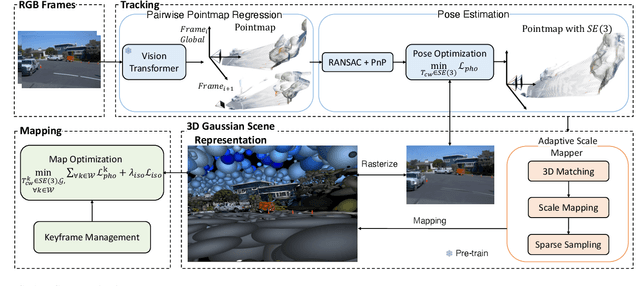
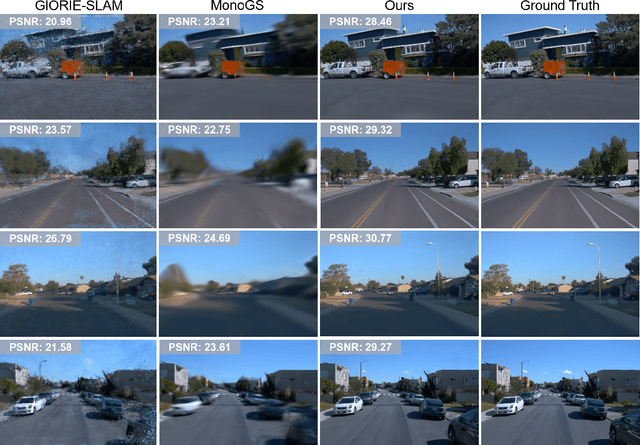
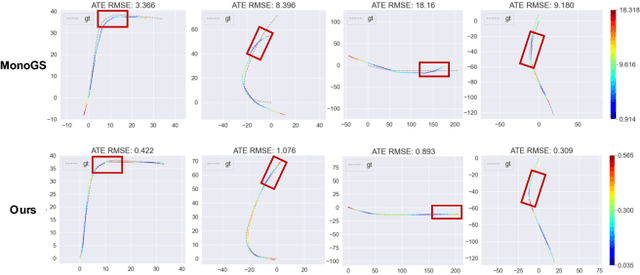
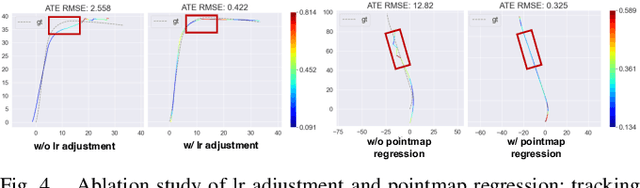
3D Gaussian Splatting (3DGS) has become a popular solution in SLAM, as it can produce high-fidelity novel views. However, previous GS-based methods primarily target indoor scenes and rely on RGB-D sensors or pre-trained depth estimation models, hence underperforming in outdoor scenarios. To address this issue, we propose a RGB-only gaussian splatting SLAM method for unbounded outdoor scenes--OpenGS-SLAM. Technically, we first employ a pointmap regression network to generate consistent pointmaps between frames for pose estimation. Compared to commonly used depth maps, pointmaps include spatial relationships and scene geometry across multiple views, enabling robust camera pose estimation. Then, we propose integrating the estimated camera poses with 3DGS rendering as an end-to-end differentiable pipeline. Our method achieves simultaneous optimization of camera poses and 3DGS scene parameters, significantly enhancing system tracking accuracy. Specifically, we also design an adaptive scale mapper for the pointmap regression network, which provides more accurate pointmap mapping to the 3DGS map representation. Our experiments on the Waymo dataset demonstrate that OpenGS-SLAM reduces tracking error to 9.8\% of previous 3DGS methods, and achieves state-of-the-art results in novel view synthesis. Project Page: https://3dagentworld.github.io/opengs-slam/
Reverse Modeling in Large Language Models
Oct 13, 2024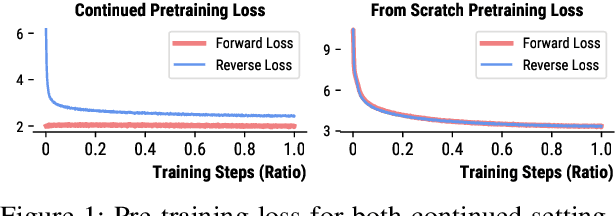
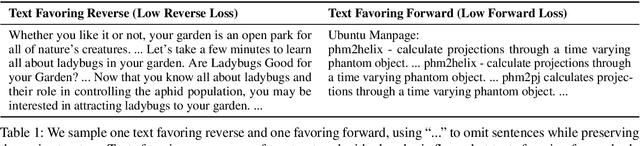
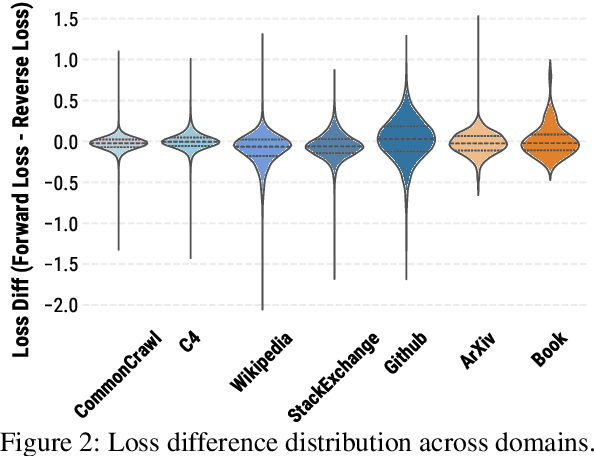
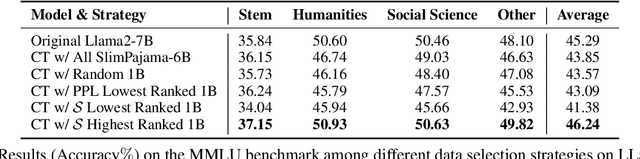
Humans are accustomed to reading and writing in a forward manner, and this natural bias extends to text understanding in auto-regressive large language models (LLMs). This paper investigates whether LLMs, like humans, struggle with reverse modeling, specifically with reversed text inputs. We found that publicly available pre-trained LLMs cannot understand such inputs. However, LLMs trained from scratch with both forward and reverse texts can understand them equally well during inference. Our case study shows that different-content texts result in different losses if input (to LLMs) in different directions -- some get lower losses for forward while some for reverse. This leads us to a simple and nice solution for data selection based on the loss differences between forward and reverse directions. Using our selected data in continued pretraining can boost LLMs' performance by a large margin across different language understanding benchmarks.
Frame-Voyager: Learning to Query Frames for Video Large Language Models
Oct 07, 2024Video Large Language Models (Video-LLMs) have made remarkable progress in video understanding tasks. However, they are constrained by the maximum length of input tokens, making it impractical to input entire videos. Existing frame selection approaches, such as uniform frame sampling and text-frame retrieval, fail to account for the information density variations in the videos or the complex instructions in the tasks, leading to sub-optimal performance. In this paper, we propose Frame-Voyager that learns to query informative frame combinations, based on the given textual queries in the task. To train Frame-Voyager, we introduce a new data collection and labeling pipeline, by ranking frame combinations using a pre-trained Video-LLM. Given a video of M frames, we traverse its T-frame combinations, feed them into a Video-LLM, and rank them based on Video-LLM's prediction losses. Using this ranking as supervision, we train Frame-Voyager to query the frame combinations with lower losses. In experiments, we evaluate Frame-Voyager on four Video Question Answering benchmarks by plugging it into two different Video-LLMs. The experimental results demonstrate that Frame-Voyager achieves impressive results in all settings, highlighting its potential as a plug-and-play solution for Video-LLMs.